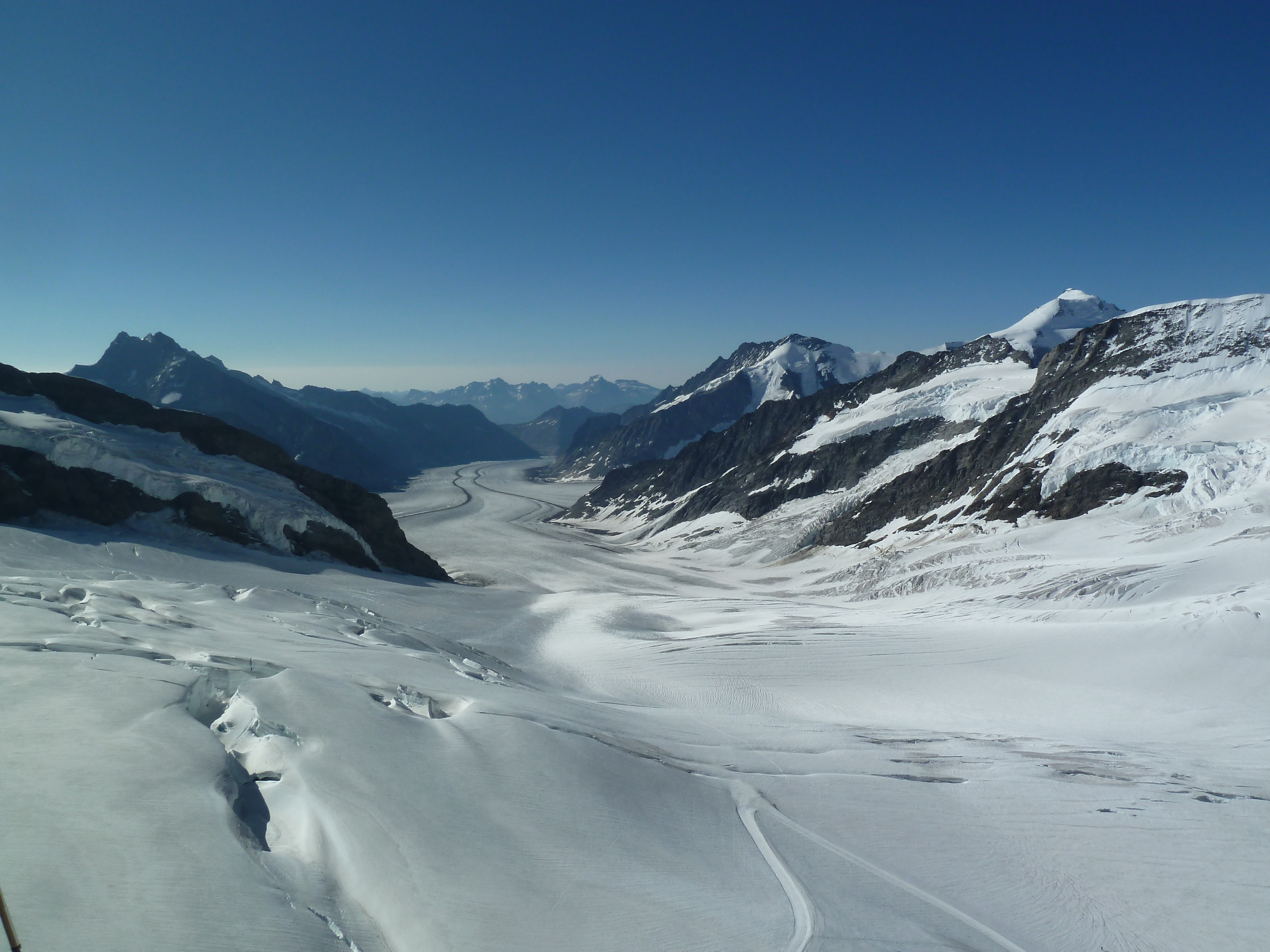
My recent travels took me to the beautiful country of Switzerland, where I found it was possible to experience winter in July. There are a few different places you can head to if this is on your wish list but none is more visited than the Jungfraujoch in the Bernese Alps.
The Jungfraujoch is a saddle which sits between two of the highest mountains in the region, the Jungfrau and Mönch. It’s incredible to think that over a hundred years ago the Swiss constructed a railway tunnel through the inside of the neighbouring Eiger mountain to reach the Jungfraujoch, which is the highest train station in Europe at 11,330 feet above sea level. It’s an amazing feat of human endeavour and makes this trip a must-do whilst in Switzerland.Planning to get the most out of your visit is essential, particularly when visiting as I did in high season. At worst you could find yourself unable to take in the spectacular views because of the crowds, the weather, or unable to go at all if the trains are sold out. There is a cap on visitor numbers each day which makes it essential to do your homework so that you can have an enjoyable visit to one of the most spectacular places in Europe. Here are my best tips for planning a trip to the Jungfraujoch in high season:
1. Base yourself nearby
It is essential to stay overnight before your trip to the Jungfraujoch somewhere in the Bernese Oberland, be that in a nearby mountain village such as Wengen or Mürren, or a little further beyond in Lauterbrunnen or Interlaken. Many travellers contemplate making the trip from Lucerne or even Zurich. The journey time from both cities to the top is around 4 hours each way. Switzerland’s trains do make travelling a pleasure, but an 8 hour round trip may be pushing the boundaries a little. Much more importantly, the weather can change in the mountains very quickly so even if the view on webcams looks clear when you set off, by the time your 4 hour journey is over the view could be completely obscured. It’s the most expensive excursion in Switzerland so to maximise your chances of having a great view when you get up there, stay nearby. If possible, give yourself a few days in the area to maximise your chance of a clear day when the views are great.
2. Check the webcams before going up
All of the popular peaks in the Bernese Oberland have webcams. The cam for the view at the top of the Jungfraujoch can be found at: https://www.jungfrau.ch/en-gb/live/webcams/ Be sure to check this before setting off on your trip and consider not going if the view is poor. And whatever you do, don’t book this trip in advance. Wait until the night before so you can check the weather forecast before considering making a definite decision. This trip really is all about the views and if the top is shrouded in cloud, you’ll likely come away really disappointed.
3. The Good Morning ticket
If you can bear to get up early then this is a great way to save money and if you’re on the first train a great way to have some space to move around for at least the first half hour or so. The Good Morning ticket is a discounted fare with the condition that you take either of the first two trains up from Kleine Scheidegg (the changeover station for the Jungfraubahn) at either 8am or 8.30am, and then make your return trip leaving Jungfraujoch by 1.13pm. The cost saving is appealing on what is a very expensive trip. I took the first train up and even though the train was full, once we got up there everybody spread out to take in the various different views and attractions so it was really easy to move about and take it in. Within an hour or two the whole area was really crowded as more trains arrived and bigger tour groups began to arrive. The early bird catches the worm!
More details on the Good Morning Ticket can be found here: https://www.jungfrau.ch/shop/en/tickets/bergbahn/angebote/jungfraujoch-top-of-europe/good-morning-ticket-jungfraujoch
4. The best attraction is the view, use your time wisely
There is so much to see once you alight the train at the Jungfraujoch station. You can visit the Ice Palace, the Alpine Sensation, watch the movie at Jungfrau Panorama, visit the highest shopping mall in Europe, play in the snow at the Fun Park, enjoy a hot chocolate or a meal… The list goes on. Make sure that top of your list is the Sphinx, the viewing platform at the top of the complex at 11,782 feet. This is really what it’s all about and where you can take in the spectacular views. Head for the Sphinx first, particularly if you’ve come up on an early train, and drown in the spectacular views. 
5. Beware the effect of altitude
Whilst the numbers are mind boggling when you consider the height of the top station, the much more important factor in travelling to an elevation of over 10,000 feet is the effect of the altitude. You will notice quite quickly that the air is much thinner, there’s less oxygen and it has an effect on the breathing of even the fittest person. It is much easier to exhaust yourself so move slower than you would at sea level and give yourself chance to adjust to the conditions. I found it a strange sensation for the first few minutes but once I slowed my walking pace a little and gave myself chance to adjust then it was absolutely fine. Symptoms of altitude sickness can be experienced at this elevation and include dizziness, nausea, fatigue, shortness of breath and vomiting. If you experience any of these symptoms then the best thing you can do is to descend from the altitude by heading back down on the train. It is not advised to bring children under the age of 2 up to this sort of altitude and it’s worth checking with your doctor if you have a child older than 2 in case of other health conditions.
6. Buy a Half Fare card
At full price this excursion is costly. The return trip from Kleine Scheidegg to Jungfraujoch is 152CHF at full price, plus you have the cost of getting to Kleine Scheidegg from wherever your starting point is. The Swiss have a range of different travel cards and passes but one of the best money saving passes is the Half Fare card which gives you a 50% discount on tickets purchased. It costs 120CHF and is valid for one month on almost all trains, buses, trams, cable cars, gondolas, funiculars and mountain railways in the whole of Switzerland. On this one excursion alone the Half Fare card will save you 76CHF on the cost of travel from Kleine Scheidegg to Jungfraujoch. It’s almost certain that you will be travelling from somewhere else to Kleine Scheidegg first and you’ll get 50% off the fare for this journey too. I stayed nearby in Wengen and the return journey to Jungfraujoch from here is 200CHF at full price. The saving of 100CHF almost pays for the Half Fare card and you can use it wherever else you go in Switzerland too.
7. Buy a seat reservation
Seats can be reserved on the final part of the trip from Kleine Scheidegg to Jungfraujoch at a cost of 5CHF each way. This is well worth the money in high season. You will join a separate queue and are guaranteed a seat on the train (though you can’t choose which seat). At busy times it is possible you will have to stand without a seat reservation and I did observe a fair amount of jostling, pushing and shoving as the trains got busier. A seat reservation avoids this hassle and means you will have a more pleasant trip up the mountain.
I hope these tips will help you to have a wonderful journey to this incredible part of Switzerland. I was nearly put off visiting Jungfraujoch because of nightmare stories of crowds and poor weather. Follow my advice and hopefully you’ll have as great a trip as I did. It was truly unforgettable!


Leave a Reply