There are things I know about myself as a traveller. I will always find the independent bookshop. I will seek out the coffee made with care. And when I cross the border into Ireland, north or south, I will be ordering a Guinness.

I adore a good pint of Guinness. Back in Ireland, there is something about it that transcends the drink itself. The ritual of it, the patience required, the way it settles slowly in the glass, dark as night with that slow-forming crown of cream. It tastes different here. It just does. And Belfast, I am delighted to report, knows exactly how to pour one.

We visited four pubs over the course of the trip. Each one different in character. All of them excellent.
The Thirsty Goat
The Thirsty Goat was our first, and it set the bar. Proper Irish stew and wheaten bread, the kind of food that tastes like someone made it with intention, followed by the best pint of Guinness of the whole trip. There is a particular pleasure in landing well on your first attempt. The Thirsty Goat rewarded us immediately.
A perfect pint of Guinness is not a thing that can be rushed, and the best bar staff know it. The glass goes under the tap at an angle, held just so, and the first pour takes it to about three-quarters full. Then comes the wait, and the wait is non-negotiable: a full ninety seconds while the cascade does its work, bubbles moving downward through the dark, the whole thing slowly resolving itself into that deep, almost impossible black. A good bartender gives it that time without being asked. Then the final top-up, the tap pushed forward rather than pulled, and the head forms: thick, creamy, pure white, sitting on top like it was always meant to be there.

Nitrogen, not carbon dioxide, is what makes it. But it is the care and the skill behind the bar that makes it worth drinking. You can taste the difference. Anyone who has been handed a pint that was rushed, or poorly poured, or just not cared about, knows exactly what is lost.
The Dirty Onion
The Dirty Onion sits in what is said to be the oldest building in Belfast, and you feel it the moment you walk in. The walls have been standing since 1680, when the place began life as a fish merchant and grocer, before trading linen, whiskey, tea and tinned soup across the centuries that followed.

Now it trades in Guinness and good atmosphere, and it does both very well. Dark wood, an open fire, the kind of interior that makes you want to settle in and stay. We happened to visit on a day when the weather had done something unexpected for Belfast and turned rather nice. The result was that most people had migrated to the outdoor terrace, leaving us in near-sole possession of a beautifully cosy inside.
I kept thinking: come back in winter. Come back on a grey, wet, Belfast-in-February afternoon, pull up a stool near that fire, and it would be close to perfect.
The Crown Bar
And then there was the Crown.
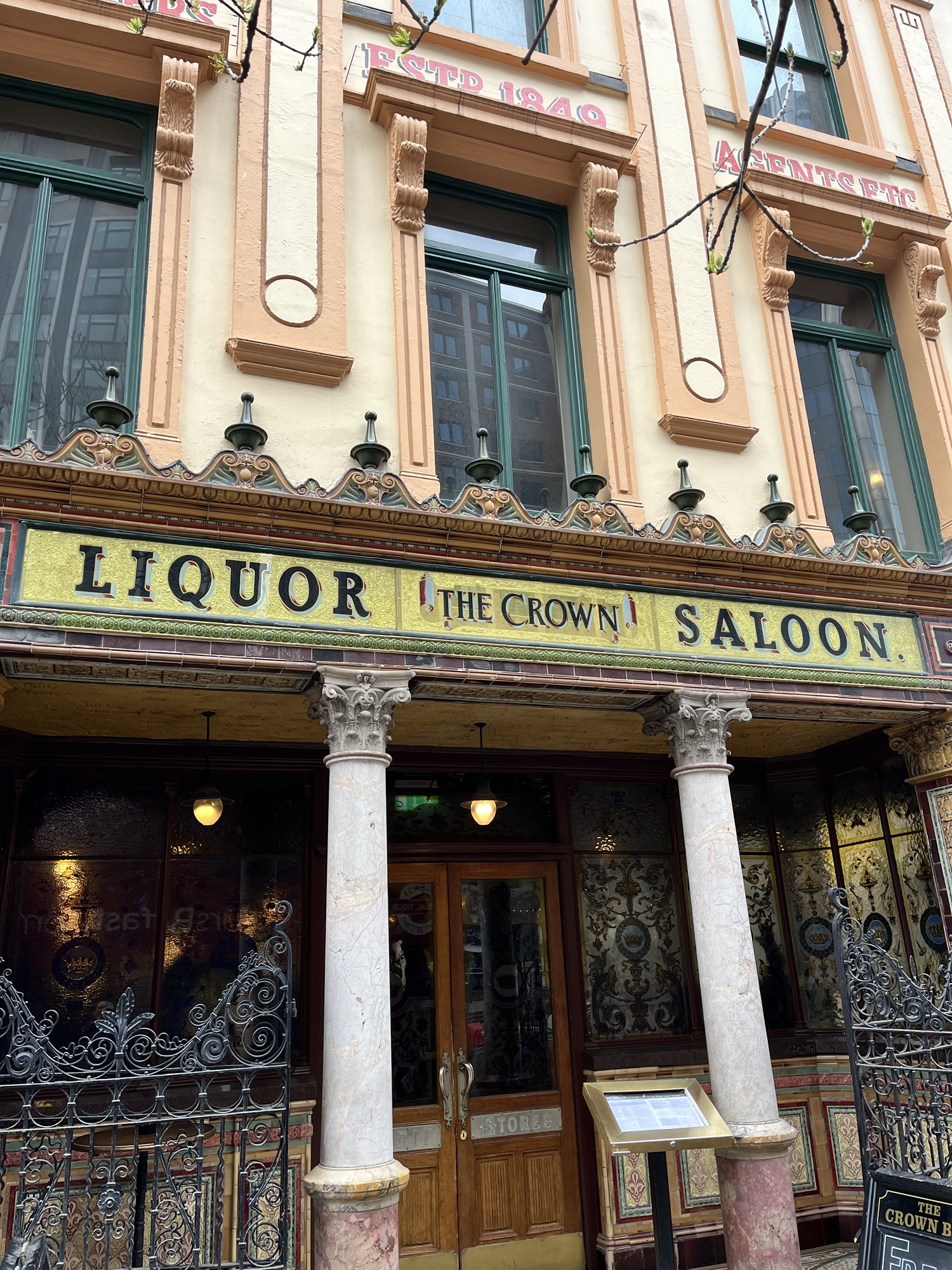
The Crown Bar on Great Victoria Street is one of those places that stops you in your tracks before you have even got through the door. The exterior alone: butter-yellow facade, elaborate tilework, the words Liquor Saloon picked out in gold, ornate columns framing the entrance. It has the air of a building that has been standing its ground with considerable confidence since 1849 and fully intends to continue.

Inside, it is extraordinary. A pressed and embossed ceiling, lacquered to a deep burnished brown, scrolls and florals overhead in every direction. Gilded columns with fish-scale detailing. Stained glass panels. The bar itself a Victorian masterpiece of carved mahogany and arched tilework, two Guinnesses settling patiently in the middle of it all.

We sat in a snug. Each snug at the Crown has its own door, its own private world of dark wood and coloured glass. Inside our snug, a small sign explained that the snugs were original, dating from the 1880s, built by Italian craftsmen working in the Belfast shipyards and on the city’s churches. They were designed, the sign said, to allow ladies and high society to have a drink without being overlooked.

I read that twice. Ladies drinking privately, discreetly, out of sight of the public bar. And here I sat, over a century later, pint of Guinness in hand, door closed, overlooked by nobody, entirely at ease. Some things change slowly. Some things change completely. The snug remains, and the women in it now drink on their own terms entirely.

The Crown is a National Trust property, which tells you something about what Belfast thinks of it. Rightly so.
Hell Cat Maggie’s
Our fourth pub took us upstairs, near City Hall, to Hell Cat Maggie’s. The bar takes its name from a real woman: born in Ireland, orphaned young, she made her way to New York and became a fighter for the Dead Rabbits, one of the infamous gangs of the Five Points district in the 1800s. Reportedly fierce enough to file her teeth into points and wear brass claw-like fingernails in a fight. The bar celebrates her story with artwork, natural woods and the kind of eclectic detail you find in an original Irish pub, all of it shot through with that Irish-American spirit.

It suited her name. Rougher-edged, warmer for it. Two Guinnesses on a shelf beside a row of old paperbacks, rough wooden planks behind them, the spines of Rumer Godden and J.B. Priestley keeping company with the pints. The kind of detail that makes you feel a place has been put together by someone who actually cares.
We were very comfortable there.
The Ones That Got Away
Belfast has two institutions I had very much intended to visit. The Duke of York, tucked down a cobbled alleyway in the Cathedral Quarter, was closed when we passed. Maddens, a folk music pub with a loyal following, appeared to be mid-lock-in, operating on a timeline of its own and apparently indifferent to casual visitors.
I am not especially sorry. It simply means there is unfinished business. There will be a next visit, and the Duke of York and Maddens will be first on the list.
Belfast knows how to keep you coming back.

Leave a Reply